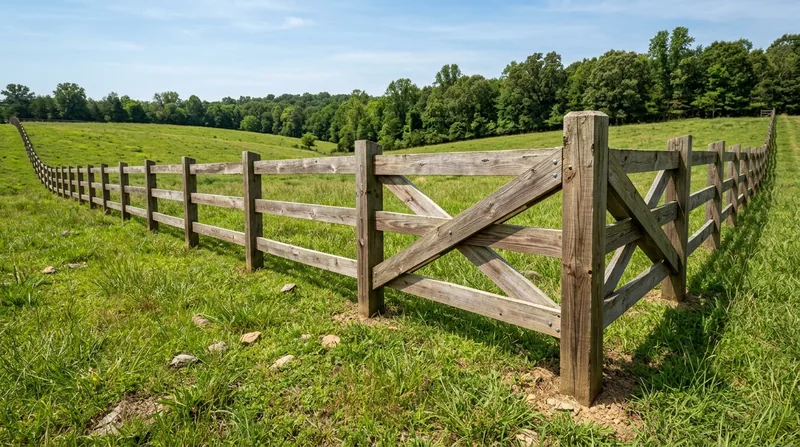




Farm fence installation in Little Rock and the surrounding counties calls for a different approach than residential perimeter fencing. Whether you're securing pasture ground in Lonoke, Grant, Saline or Jefferson counties, or protecting row-crop acreage just beyond the county line, your fence has to handle livestock pressure, weather exposure, and the equipment that moves through your gates every day. Little Rock Fence Pros has been building ranch and field fencing since 2012, and we know the work required to make a fence stand up to the real demands of farming and ranching in central Arkansas. We work with ranch rail, no-climb horse fence, field wire, and pipe fencing, and we build gates that open reliably and close securely. Our crews handle the layout, post spacing, bracing and hardware that keep a working fence working.
Why Farm and Ranch Fencing Matters on Acreage Near Little Rock
A residential privacy fence and a working ranch fence solve different problems. Residential fencing carries aesthetic weight and defines property lines; ranch fencing contains livestock, resists weather and equipment impact, and needs to stay secure for years without constant repair. Post spacing, rail diameter, bracing geometry and gate hardware all reflect the load and the duty cycle. Corners and gate openings take the hardest wear, and a fence that holds at the perimeter will fail fast if the posts are undersized or the bracing is missing where livestock test it most.
- We set posts deep in concrete and space them to resist lateral and vertical load from livestock and weather.
- We install anti-sag bracing at corners and high-stress points to keep rails straight and gates aligned.
- We use pipe, ranch rail and no-climb wire sized for the animal type and the terrain exposure on your property.
- We build gates with self-closing and self-latching hardware so equipment and animals move safely through without manual intervention every time.
- We work from your existing survey or the line you identify, and we confirm utility locate marks before we dig any post hole.
The result is a fence that works for a season and keeps working for decades.
Key info: Arkansas law requires a utility locate (811 call) before you dig post holes on any property. We handle that step as part of the estimate and layout. Marks stay valid for 30 days, so timing matters if you're planning a large installation.
For more detail on what goes into a fence that holds, see our guide to fence post repair and replacement to understand the common failure points we see and how to prevent them.
How We Build Farm and Ranch Fencing: From Layout to Gate Hanging
Every job starts with a site walk and a clear conversation about what the fence needs to do. Are you containing horses, cattle, or both? Do you have equipment that has to pass through the gate? What's the terrain like, and where does water drain? The answers shape the post depth, rail choice, bracing plan and gate style. We work methodically through the layout, mark post locations, call for utilities, and build to a standard that survives the real pressures of farm and ranch work in central Arkansas.
- We walk the property line, identify high-stress points, and mark post locations to match the terrain and the load.
- We call 811 for a utility locate and wait for marks before we dig any hole.
- We dig post holes to depth, set posts in concrete, and brace them at corners and gates to resist lateral shift.
- We install rails, wire or pipe sized for the animal type and the exposure, and we hang gates with hardware that closes and latches reliably.
- We walk the completed fence with you and confirm that every gate operates smoothly and every section meets your expectations.
A working fence is built to a system, not improvised on the fly. That discipline saves you money in the long run.
Local example: A 40-acre pasture property in Jacksonville with three paddocks and a separate loading gate requires careful post spacing, anti-sag bracing at every corner, and gate operators that handle daily use. We size the posts, plan the bracing, and hang the gates so the whole system works as one. That's the difference between a fence that lasts five years and one that lasts twenty.
If you're also managing existing fencing that needs attention, our fence repair service covers post replacement, rail repair and gate adjustment on working fences.
Farm and Ranch Fencing Methods and Materials
| Approach | Description | Best for |
|---|---|---|
| Ranch Rail | Solid wood or composite rails installed horizontally on sturdy posts, typically three or four rails high depending on animal type. | Horses and mixed livestock; high visibility and traditional appearance on acreage. |
| No-Climb Horse Fence | Wire mesh with small openings mounted on wood or pipe posts, designed to prevent hooves and legs from passing through. | Horse paddocks and pastures where injury risk must be minimized and visibility is secondary. |
| Field Wire and Pipe | Steel pipe posts with high-tensile field wire, often with barbed wire strands for additional containment and security. | Cattle, mixed grazing, and large open acreage where cost efficiency and durability matter most. |
| Split Rail with Wire | Traditional split rail construction with wire backing to prevent animal escape and reduce injury risk from sharp rail ends. | Mixed-use properties and heritage properties where traditional appearance and function must balance. |
| Pipe Fence Gates | Heavy-duty steel pipe framing with self-closing and self-latching hardware, sized for equipment passage and daily livestock movement. | Any ranch property where the gate must open and close reliably without manual intervention every time. |
Each method carries different labor, material and maintenance profiles. We help you choose the right fit for your animal type, terrain and budget during the free estimate.
Farm and Ranch Fencing Cost in Little Rock: What to Expect
Farm and ranch fencing cost varies significantly based on the material, the terrain, post spacing, bracing requirements and gate configuration. Field wire and pipe fencing typically starts at $11 per linear foot for basic containment on flat, accessible ground. No-climb horse fence and ranch rail run higher because of material cost and labor intensity. Gates and bracing add cost, but they are not optional if the fence is going to work.
The factors that move price up include terrain that requires stepped or racked installation, rocky or clay soil that demands additional digging effort, tight post spacing for high-stress areas, multiple gates with self-closing hardware, and the distance from your property to our staging area. A 10-acre pasture with three paddocks and two gates will cost more per linear foot than a simple perimeter fence on flat ground, because the work is more complex and the hardware load is higher.
We always recommend getting two or three estimates from contractors who will walk your property and explain their post spacing, bracing plan and material choice. The lowest price is not always the best value if the fence fails in five years. Our pricing reflects the labor and material required to build a fence that works for two decades.
For a detailed breakdown of pricing by material and service type, visit our pricing page.
Farm and Ranch Fencing Near Me: What Little Rock Homeowners Should Know Before Hiring
Hiring a fence contractor for farm and ranch work requires the same care you would give to any major property investment. Look for a contractor who will walk your property, explain the post depth and spacing they are planning, confirm that they understand your animal type and terrain, and provide a written estimate that itemizes material and labor. Ask for references from other acreage properties they have fenced, and call those references to ask whether the fence still works and whether the contractor was easy to work with.
Verify that the contractor is fully insured and holds the relevant credentials. We are members of the American Fence Association and have been in business since 2012. Check with the city or county building department to confirm whether permits are required for your fence height and setback in your specific area, and whether deed restrictions or HOA architectural standards govern your property. Some acreage properties are subject to county setback rules; others are not. That varies, so confirm before you start.
Confirm that the contractor will call for a utility locate before digging any post holes. That is the law in Arkansas, and it protects you and the contractor from hitting buried lines. A reputable contractor will build that step into the estimate timeline and never skip it.
Ready to discuss your farm or ranch fencing project? Contact us for a free estimate. We serve Little Rock, North Little Rock, Conway, Jacksonville, Sherwood, Benton, Bryant, Maumelle and surrounding areas, and we cover Lonoke, Grant, Saline and Jefferson counties. Call us at (501) 476-2299 or request an estimate online, and we will walk your property and give you a clear price within 24 hours.
Farm & Ranch Fencing in Little Rock: Pricing Guide
| Service | Price | Details |
|---|---|---|
| Field Wire and Pipe Fencing | Starting at $11/ft | Basic containment fence on flat, accessible ground with standard post spacing and concrete-set posts, no gates |
| Ranch Rail and No-Climb Horse Fence | Starting at $18/ft | Wood or composite rail with wire backing, sized for horses and mixed livestock, includes anti-sag bracing at corners |
| Split Rail with Field Wire | Starting at $14/ft | Traditional split rail construction with wire backing for safety and containment, labor-intensive installation on variable terrain |
| Gates with Self-Closing Hardware | On estimate | Pipe or wood frame gates with self-closing and self-latching hardware, priced by size and equipment load requirement |
| Stepped or Racked Installation | On estimate | Terrain-dependent installation on slopes or uneven ground requires additional labor and custom bracing design |
| Free Estimate | No obligation | Site walk, utility locate coordination, and written quote within 24 hours. Call (501) 476-2299 anytime |
Indicative pricing, the exact cost depends on square footage, finish, and site access. Free personalized estimate within 24h at (501) 476-2299.


